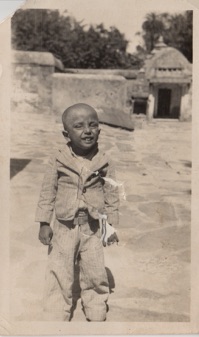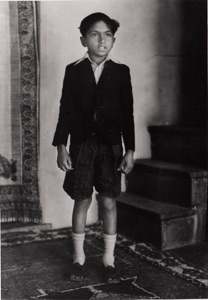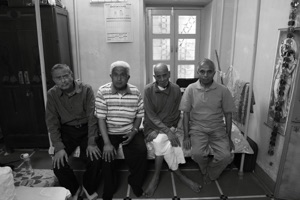

I was born in Kapadvanj on May 3, 1936. As I have mentioned, as a child, I grew up in a vast joint family. There was Dada and Moti Ba (Rukhi Ba) with their two unmarried daughters, Vimla and Shushila, and their two unmarried sons, Manubhai and Kikabhai. There were also their two married sons, Chimanlal and Nagindas (my dad), their wives and children, Ramesh, Indira, Kokila and myself. As grandchildren of a reasonably well-to-do man we were all pampered. As is the custom, boys especially were pampered so Ramesh and I were both spoiled as children. Ramesh was pampered even more because he had lost his mother and in addition he was also the first grandchild for both sets of grandparents. If I was a small brat, then he was a big brat. Nonetheless, we all grew up very close with one another. Even after the family was split into the three family houses, since the houses were adjacent, we lived like one big family. We also saw Chiman Kaka’s house being built as well as the addition of a fourth satellite family home in Mumbai, where Manu Kaka settled. Two of his sisters, Dhiraj Foi and Prabha Foi had also settled in Mumbai but as was (is) tradition their homes were their husband’s family’s homes and thus not considered a family home to us.
We never called my father “father” but rather called him kaka. Since we were living in a joint family, I picked up that habit from Rameshbhai who of course called my father “kaka”. Surprisingly he too called his father kaka even though he was the oldest. This tradition has continued and their children called all three of their fathers (Chiman Kaka, Kika Kaka and Nagin Kaka) kaka in place of father. Our grandparents also had the habit of calling their daughters-in-law by their first names, living in a joint family us kids picked up this habit too and called our mothers by their first names instead of mom. Somehow, I always preferred Dada’s company to my father’s. He was too busy with his business and religious affairs and rarely talked to me. Dada, on the other hand, will always take the time to talk to us. He was well read and far more knowledgeable about the world then many people of his age group (and my father as well). Most of them were concerned only with their religion and their business. Everything else was never much of a factor in their life. Dada would read newspapers, magazines, and novels too (in Gujarati). He followed current events, the world wars, the independence movement (one of his sons, Manubhai, was actively involved) as well as recent Indian history (the Moguls, Marathas and the British colonialization). He would talk with us about any of these subjects. He would also talk about things from his childhood, what he learned from his father and what he had gone through with his community when he dared to differ from them.
Father also insisted we attend formal religious school (Pathshala). At this school we were supposed to study and memorize religious prayers and hymns by reading and reciting it repeatedly. As I grew older, I became increasingly bored with it. We also had to go to hear the sermons at the Upashrya and spend time during the weekend and during vacation to do samayik and pratikraman. Again, these rituals too became boring for me and I refused to attend. Of course I had friction with my father about this. Lila was disappointed, but would only say that it would be nice if I followed the rituals. On one occasion a child sadhu was visiting the Upashrya and I was sent to go and play with him. He asked me about the games kids played in the street. I told him about marbles, gilidanda (a game similar to baseball) and cards. He was somehow fascinated with cards and so I taught him some card games. When father found out he was really mad. Sadhus are supposed to live the simplest kind of life, the games I taught him were against his religious vows even though he was just a small boy. There is a practice among Jains that many children take diksha and become a sadhu if they are from an orthodox Jain family. They are raised to believe that this is the best thing to do for their own salvation. Some children take diksha along with their parents or another family member or may choose to do so on their own. The children are not forced to, but are raised in such a way that they would choose to and it would be an ashatana (blasphemy) for their parents to tell them no or to wait until they are older and more capable of making such a choice. For Digambara and Swetambara Jains, the Acharya is the only one who may refuse someone or tell them to wait (for lack of maturity, health or any reason), but very few exercise this power. In the Sthanakavasi and Terapantha tradition, children are not given diksha and adults must go through religious studies and mental exercises, essentially adopting the sadhu life before they take diksha.
We were lucky to be growing up at the time we did for many reasons. As children, we saw two fois and two kakas get married. Vimla Foi’s wedding was first, and per the custom at that time, it lasted more than a week. Manu Kaka’s wedding was also something special. At the time of his wedding (194?) electricity throughout the town had been shut down. Homes had switches and fixtures, but the wires that ran from houses to the power plant had all been taken by the British for their war effort as previously discussed. Manu Kaka’s father-in-law, Ramanlal Manibhai Parikh, was a very wealthy, well-respected and influential cotton merchant. He was considered the Nagar Seth of the town. Nagar Seth is an honorary title bestowed upon an individual or family by the town based upon one’s philanthropic deeds for the town. This title is typically hereditary as the family carries on this tradition. He arranged for a generator to be brought in for this occasion and the Mandap and surrounding areas were all lit. The wedding was also memorable because Manu Kaka broke the old tradition of a groom arriving to the wedding ceremony on a horse. Despite objections from both sets of parents, he arrived on foot. Sushila Foi’s wedding would come next, followed by Kika Kaka.
It was also during this period all of my siblings were born, Chandrakant in 1940, Dinesh in 1943, Mahendra in 1945, Jyotsna in 1948 and Anjana in 1950.
Both Dhiraj Foi and Prabha Foi lived in Mumbai and would come to Kapadvanj every summer with their kids. After her marriage, Vimla Foi also moved to Mumbai and would have this same schedule. It was like one big party for several weeks. Everyone would eagerly await their arrivals, particularly Dhiraj Foi. She was wealthy and generous and would bring lots of fruits and sweets for all her relatives and friends. Each night she would have a gathering on Dada’s terrace and all her siblings were required to attend. She liked to talk a lot and if any one would doze off during this time, she would shout and scold and sometimes even smack her brothers if they dared to fall asleep. For us kids it was fun to watch this happen because as kids we couldn’t otherwise imagine anyone scolding our fathers.
Around 1949, Dhiraj Foi had her old two-story house in Kapadvanj (from her husband’s side) demolished and built in its place a new four-story house. My father was put in charge of supervising this and Savaibhai (her eldest son) stayed with us for one and a half years to assist him. I was very much excited about the activity and would go there after school and watch the house being built. Foi wanted her daughter Kalabhen and son Savaibhai to be married from this new house. Foi was able to see Kalabhen get married, but she unfortunately passed away before Savaibhai was married.
As I mentioned, in 1949 father transferred me to the municipal (government) school. I was suddenly in a new environment and had to make new friends. One result of this switch was that I had three completely different groups of friends; one from our street (Dalal Vala) and the Jain community, another from my early school days and a third from the classmates at the municipal school. All three groups were of a completely different background and outlook. Only a few boys from each group would continue their education beyond high school. Some would join their family business and some would have to find jobs. Most of the girls were engaged during the tenth or eleventh grade of school and by the time I was in engineering college they were married. Originally, I was told that I would go to America for graduate studies, but as I was completing the SSC exam (a high school graduation exam given by the state education board which is a prerequisite for any kind of higher education), my father was in big financial difficulties. For a long time I was not sure whether I would even go to college or have to find a job. My father never spoke of his financial troubles or of my future studies, instead it was my mother who came to me and said that I needed to get a job as we didn’t have the money to send me to school. A few days later, Manu Kaka came to me and said that I would be coming to Mumbai to live with him and that he would pay for my studies. To this day I still do not know how this came about, if Manu Kaka approached my father with this plan or if my father went to him.
World War II began when I was only three years old, but as I grew up I heard people talking about it. One of the most striking things was that all electric power was gone and suddenly we were back to using kerosene lamps. Streets were dark at night; things were in short supply and everybody new it had to do with the war. However, despite what was happening in the war, most people were happy that the British were getting beaten. Most people believed they deserved it and older religious people said they were being punished for their sins. In 1943-44 there were rumors that the British Government was going to move its headquarters from London to Delhi. Around this time, there was a big explosion in Mumbai Harbor and two huge steamers blew up. The explosion (listed as one of the worst non-nuclear explosions of the 20th century)caused many burning parts of the steamers thrown all over the main city and many buildings burned. Many people fled the city thinking that the Germans were bombing Mumbai, not realizing that it was just an explosion. During this explosion, lots of gold bullion rained all over the city and people scrambled for them. The government never confirmed it, but it was rumored that the steamers contain the British Treasury’s portion of the government move from London to Delhi. When I was in fifth grade I found a book published by a well known Gujarati daily news paper called Janmabhoomi. It was a short account of the war with maps, history, explanations and illustrations. Always curious about the war, I read the whole book. I have been interested in world history, geography and maps ever since.
World war II created many problems in India (and all of south Asia). The basic problem was a shortage of everything, most especially of food. Even though the war stopped at the eastern border of India, most of the British armed forces were basically of Indian origin (about three million Indian soldiers). All of the allied forces (British, American and others) in the East against Japan and in west in Northern Africa against Germany were getting most of their supplies from India. The result was a man-made shortage of supplies and food in India. The areas in eastern India and Bengal (both the Indian state of West Bengal and present country of Bangladesh) suffered the most. Such large quantities of rice (a staple food for most people) was sent outside of the country that despite 1942 –43 being a lean year (leaving enough to barely get by but not dire) that an actual famine occurred in the countryside of Bengal. By some estimates, about 3 to 4 million people died of starvation. Poor people migrated from these areas to all over India. We as kids witnessed some of these people even in Kapadvanj. Calcutta, a city of about two million and at the time considered to be the grandest city of Asia, was swarmed with three million refuges and began to decline. Before the city was able to recover from this shock, partition came and with that another huge influx of refugees arrived. To this day, the city has not recovered from this double whammy got the nickname of the world’s biggest slum.
Finally, rationing was introduced with the aim of distributing food evenly to all and at reasonable price. Every family was given a rationing card and would get a fixed amount of food based upon the number of family members (adults and children had different quotas.) All basic items of food, wheat, rice, bajri, jowar, sugar, oil, legumes, beans and brown sugar and also kerosene were included. I remember standing in line to get some of these items. Sometimes before my turn came the item would be out of stock and we would have to come again the next day or perhaps even after a few days when the item was once again available. It was not long before corruption began and supplies were being smuggled from one state to another or even from one district to another. Those who had money would buy items from the black market. When wheat had to be imported (after 1947), the dark brown wheat of the US and Canada were unpopular among the wealthier classes and a barter exchange of wheat began. The wealthy would trade the poor two pounds of the darker wheat in exchange for one pound of the light grain Indian wheat. Also, due to the shortage, all kinds of parties and gatherings were prohibited to avoid wastage of food. For the first few years, people followed the regulations. Then the rich and the influential started parting anyway, bribing the police and government officers.
On the one side you would read in the newspaper about famine and hunger in some parts of the country and on the other side you would see big parties and a tremendous waste of food. Some people, including myself, did not like this behavior and avoided these parties. Sometimes, if people were nervous about being caught, they would have multiple gathering places so it would not seem like a big gathering. Once, I got very upset about a wedding party that was going to happen. It was for a cousin of my father’s. They most likely had given a bribe to be able to have the party. I went and complained to the district officer and asked him to stop it. I was quite naive since he was no less corrupt than the others and warned the people who were having the party about my complaint. For appearances he had to send someone to look into the matter. The party went on as planned and my father and Chimin Kaka scolded me for misbehaving.
Rationing was slowly lifted and by 1951/52 all things were once again available. What was, or rather is, left behind is corruption. And unfortunately it has spread to every aspect of life in India. Any time there are any rules, regulations to be followed or legal permit required, bribing the concerned government officer(s) has become the norm.
During the Independence Movement many people took part in the struggle and many went to jail. I was very young, but I do remember the protests, processions and the excitement. I also remember the hartals (strikes). Even when we were very young we participated and took part in student rallies. Gandhiji was the most popular figure and we celebrated his birthday with a big festival. Made out of lights, a replica of his hut at the Sabarmati Ashram would be created and his photo would be placed inside it. Lights were hung in similar fashion to the Diwali celebration. Many times Churchill’s effigy would be burned along with the Union Jack. People would make an effort to try to wear clothes made from Khadi cloths (a home spun cotton) and shops selling any British made goods would be cordoned off and forced to close and sometimes even stoned.
We also had a special reason be excited, since Manu Kaka, after his graduation from Law College, had joined the Independence Movement. Manu Kaka had gone underground several times, once prior to his first arrest and then again before his second arrest. He was jailed twice, once in Ahmedabad at the Sabarmati Jail, and once in Mumbai at the Worli Jail. The first time he was imprisoned he was caught by the British government. On the second occasion he turned himself in because his family was being harassed and pressured by the government. When he was imprisoned at Worli, Dhiraj Foi would go to visit him and bring him food. By policy in order to visit an inmate you had to have obtained permission and they would give you a set time for the visit. Dhiraj Foi, however, as per her nature would come on her own schedule and argued successfully with the Warden to gain entry as it was her god given right to see her brother. In the prisons, inmates were fed very course meals (Kaka suffered digestive trouble for the remainder of his life as a result), but Foi was also able to successfully argue that she should be able to bring her brother food as well. By 1944 it was almost certain that the British would be leaving as soon as the World War was over. However, by then communal riots had begun and by 1947 when the country was divided, while the exact numbers are not known, it is estimated that millions were dead and millions of others were displaced. We were returning from a jatra to Taranga when on our way towards Ahmedabad we saw the Sindh Mail Train (which ran from Karachi to Ahmedabad) tremendously overloaded with refugees. People were sitting on the roof of the train and spilling out from the doors. Upon arrival at the Ahmedabad Station, we were not allowed leave the station as the entire city was under curfew. We could see huge fires from distance.
The British Government had set up a very self-serving arrangement of government. Their main interest was business and from the beginning they helped some rulers that were willing to rule in a manner against others, that were willing to act on behalf of British interest and in return for their loyalty were given additional land. By 1830, the whole of India was divided into areas directly ruled by the British Government and areas governed by these Princely States. They were vassal kingdoms of the British Empire. The British handled foreign relations and trade but the local rulers were completely independent in local matters. Many of the larger states like Mysore, Baroda, Udaipur and Jaipur had their own currencies; many even had their own railroad systems. A few of the more progressive states like Mysore, Baroda and Travankore developed educational systems and health care. Unfortunately, most did nothing to benefit their people and just built palaces and indulged in luxuries for themselves and their families. They were quite rich and legally they were independent nations. In many instances, moving from one state to another meant paying customs. As children I remember we paid customs every time we went to Palitana or Udaipur. British currency was legal tender everywhere, but nonetheless in some remote villages only local currency would be accepted. There may have been as many as 30 different currencies in the country. Originally started by the Moguls and continued by the British, the official British currency was the rupee. The rupee was divided into Annas, sixteen Annas equaling one rupee. The Anna was further divided into Paise, with four Paise equaling one Anna. The smallest denomination was the Pie, with three Pies equaling one Paise (192 pie equal to one rupee). After independence, India made a new coin called Naya Paise with 100 Naya Paise equaling one rupee. The rest of the national coins and regional currency were abolished along with the some seven hundred or so princely states. Many of those states had wanted to be independent and separate nations. Some were convinced to remain a part of the new India by diplomacy, others were coerced and still other rulers were forcibly removed by the armed invasion. These rulers were given yearly compensations and allowed to retain their personal properties. By merging the many small kingdoms, new provinces and states were created. This was a big achievement and was a tremendous task for Sardar Vallabhbhai Patel. Some referred to him as the Bismarck of India. In truth this accomplishment in India was far more complicated and larger in scope; Germany is only 1/10th the size of India, had only one language and predominantly one religion.
While we were all going through vast changes in the country, there was a lot happening at home as well. My father had started his own business in Kapadvanj. Initially he had gone to work with his father in the family business in Anghadi. However, his dealings with the farmers and sharecroppers were dishonest and they complained about being cheated to Dada. Since Dada was such an honest and reputable zamindar he was very upset by this and he and my father had many confrontations over this. In the end Dada told him to start his own separate business and gave him some money to help him get started. In 1948/1949 my father established a wholesale business that bought peanuts and peanut oil from local markets and exported it to outside areas. He also imported wheat, brown sugar and cattle feed and sold it in the local market. For a few years he did a good business but then a shortage of wheat in India meant that the government began to import wheat from the USA and Canada and state rationing took over the oil business. Father then also entered the commodity market to try and recover the loss of business. It worked for few years, but then he began to run big losses. Then about 1951/52, his brown sugar and cattle feed imports were ruined by heavy rains while on a freight car bound for Kapadvanj. The loss was so severe that it meant the end of his business. He struggled to come back from his losses, but could not do it. In fact, the repeated failure just served to make him depressed. In order to repay his loans to the bank, he was forced to empty his savings, use his insurance and sell the gold he had collected. He was left only with the house his father had given him.
During the time when father’s business dealings (both with Dada and on his own) were successful, he bought expensive furniture (largely from the Vora Muslim community as discussed). He also bought expensive utensils and jewelry. The Cartier watch and the china were brought from Calcutta during a visit to Sametshikar and another pilgrimage place in Bihar. He also bought a radio. This was first radio in Dalalwada. Every evening neighbours and relatives will come to our house to listen the radio. News and a program by Saigal and other singers were main attractions. When he went on business trips to Punjab, Utter Pradesh and Maharashtra he would buy lots of gifts for all of his brothers, sisters, their kids as well as for our home. My father also had a love of fruits and sweets and would buy them in large quantities. He would also buy the very best of clothes for himself and his family. He would wear jubah’s made of costliest silk. Even after he lost his business it took him a long time to adopt to less costly clothes.
Some other remarkable memories of my family from my childhood:
Champa Ba had shortened all of our names. I was Pavan, Chandrakant was Chando, Dinesh was Hatish, Mahendra was Mokum, Jyotsna was Harkandoshi and Anju was Shakaridoshi. We all took it lightly except Dinesh who would get mad and correct her every time.
Kapadvanj had a nice theater and as a child I saw some good plays by companies from Ahmedabad and Mumbai that would occasionally visit. I would go to these plays with my parents or an uncle or aunt. Then movies become popular and the theater was converted into a cinema house. With the popularity of movies, another brand new movie theater was built. We kids used to watch many movies. Most of them were in Hindi and some in Gujarati. Then for a while English movies were shown every Sunday morning and afternoon. I saw the whole series of Tarzan movies and a few Abbot and Costello films. To attract the villagers some of the producers made movies drawn from and based on the Ramayana and Mahabharata. They became really popular and in small towns like Kapadvanj they would run for a long time to satisfy the demand of villagers. Some of the villagers would even throw money on stage when Rama or Krishna appeared on screen. We would get upset with the prolonged engagement of these types of religious pictures because we already knew the stories and had to wait for the new movie. The longest running movie was Bhakat Hanuman that ran for about two months. Tickets prices ran from 4 Annas up to 1 Rupee.
Chandrakant got very sick when he was about two or three years old. He had a very high fever and very bad rashes on his skin, particularly around his neck. None of the medicines prescribed worked and the doctors said there was no hope of recovery and that he would not live for very long. Dr. Ravi Shanker Trivedi, a close friend of Manu Kaka’s from their school days and the independence movement, came for a visit, saw Chandrakant and was able to diagnose the problem. He told father to get a special medicine that was available in only a few places. There was a pharmacy in Ahmedabad that had it and with this prescription and note from Dr. Trivedi father went to Ahmedabad by hired jeep (taking me along) and brought back the medicine. It worked and Chandrakant recovered. One of the side effects was that he didn’t start talking until the age of six or seven.
Anju had made habit of sleeping on the pat downstairs and when we went upstairs to bed I had to pick her up and take her upstairs. Sometimes she would really be asleep and sometimes she would fake it so that I would have to carry her up to bed.
While playing around walking on the wall of an estate just outside the town, Mahendra fell and broke a bone in his hand. Afraid that he would be spanked, he didn’t tell anyone. After a few days when the pain had become unbearable, he confessed to Lila that he had had a bad fall. The doctor said he had a broken bone and he was taken by Babubhai (Chimin Kaka’s legal clerk) to Nadiad to see a hadvaidya (an ayurvedic bone specialist) to be treated. It did not work, so I then had to take him back to Nadiad to the Nadiad Mission Hospital and admit him. Father was in Mumbai and he came straight to the hospital. Dr. Stanley, the chief physician, was mad at my father and me for bringing him in so late and getting treatment as he put it “from that stupid hadvaidya”. The doctor operated and fixed Mahendra’s hand. He still has a scar from that experience as a souvenir.
Sheela (Kashmira) was known for her stubborn nature from childhood. When she wanted something that was it, she wanted it and so everyone would say that she was like “Mahisagarno pathro” and hence got her name Sheela (which means stone. She also had lots of hairs that were somewhat wild so she was also called Jafari. In keeping with our family habit of calling people by the incorrect name, all family members called her Sheela and she is known almost exclusively by that name. People are surprised to learn that her name is actually Kashmira.